PRESSURE GRADIENT EFFECT
In fluid dynamics, a pressure gradient determines which direction everything flows. In human economies, the gradient runs on money. Wealth flows from the compressed many to the comfortable few. Not randomly. Not accidentally. Directionally, structurally, and continuously.
This is the Pressure Gradient Effect.
A manifesto on pressure, density, and the behavioral architecture that money builds around us.
2026
ABOUT 32–40 MINUTES · READ IT LIKE A BOOK, NOT A FEED
Read the essayMoney shapes outcomes. Pressure shapes behavior.
Wealth rises, concentrates, and separates.
Most people move within it. Few step outside it.
No one is permanently free from it.
If you finish this and your first instinct is to point a finger at a political party, a government, a president, a country, or a person, you have missed the point entirely.
This is not about left or right. This is not about one nation or another. This is not about any leader or any law. This is about a structure. An institution so large it has no name. An invisible thing built from money, pressure, and time that every living person can see but no single person controls.
The moment you blame a face, you have let the structure off the hook. The structure does not have a face. It does not run for office. It does not give speeches. It sits underneath all of them, and it will still be there after every one of them is gone.
Read this for what it is: a mirror, not a weapon.
You will see names in this document. Countries. Alliances. Operations. They are not accusations. They are examples of the structure expressing itself through whichever hands happened to hold the tools at the time. If you swap the names, the pattern does not change. That is the point.
THE REALITY
Money shapes outcomes. Not opinions. Not intentions. Not hopes. Outcomes.
In this system, money is not a preference. It is the architecture. It determines who eats, who sleeps safely, who moves freely, and who stands still. It is the invisible hand that writes every schedule, dictates every choice, and draws every boundary. You do not decide how to live. You decide how to live within what money allows.
Money decides survival. Money decides stability. Money decides opportunity. If money decides outcomes, it decides behavior. Not because people worship it. Because they must navigate it.
And here is what no one says plainly enough: everyday humans decide what money is worth. Not an autonomous system. Not an invisible hand. People.
A committee in Washington decides the interest rate. That decision changes the cost of every mortgage, every car loan, every credit card balance in the country. A trader in London decides what one currency is worth against another. That decision changes the price of food in a country six thousand miles away. An employer decides what a job pays. A landlord decides what rent costs. A legislature decides where the minimum wage floor sits. A trade negotiator decides which industries survive and which get fed to foreign competition.
None of this is natural law. None of it is physics. Every number you live inside was chosen by a human being. The price of bread. The cost of insulin. The interest on your debt. The wage for your labor. Chosen. Set. Decided. By people who will never feel the downstream weight of the number they picked.
The decisions are so distributed, across so many institutions, so many desks, so many conference rooms, that no single person appears responsible. That is not a conspiracy. It is something worse. Diffuse intentionality. A thousand small choices, each one rational from the desk where it was made, each one invisible to the person it lands on. No one is steering. Everyone is rowing. And the boat goes where the current of accumulated small decisions takes it.
Often these decisions are disguised as helping the poor. More often they are designed to keep the poor in place. Not out of hatred. Out of arithmetic. Your position is useful. Your labor is useful. Your consumption is useful. Move you up and the numbers change. Keep you where you are and the spreadsheet stays clean.
Back to contentsMSO: THE CORE MECHANISM
MSO: Money Shapes Outcomes
What you eat is determined by money. Where you live is determined by money. How you spend your time, what risks you take, who you know, what doors open, what doors stay locked. All of it runs through money.
You do not move freely. You move within access. Access is not earned equally. It is not distributed fairly. It is concentrated, gated, and compounding. The further you are from it, the harder every step becomes. The closer you are, the easier the next step is.
Back to contentsTHE LOCUST EFFECT
In the desert, there is a creature that lives two lives.
The desert locust, in its solitary phase, is a quiet animal. It is green or brown. It avoids other locusts. It eats what it finds and moves on. It causes no damage. If you saw one, you would call it a grasshopper.
But when the population density crosses a threshold, when too many of them are packed into the same space competing for the same food, something changes. Their neurochemistry shifts. Their bodies transform. They change color. They grow longer wings. They become aggressive, gregarious, and they swarm. They consume everything in their path. Entire regions of cropland. Gone.
Here is what matters: the locust and the grasshopper are the same animal.
Same species. Same genome. Same DNA. The only variable is density. Pack them together and the phase change triggers. Give them space and it never does. A grasshopper that lives its entire life with adequate room will never become a locust. It will never swarm. It will never destroy. Not because it is morally superior. Because the environment never demanded the transformation.
Humans are not immune to this.
As economic pressure increases, as density rises, as the gap between the number of people and the resources available to them widens, human behavior shifts in the same direction. Not because people become worse. Because the environment selects for different behavior. Connection becomes transaction. Patience becomes urgency. Community becomes survival. Generosity becomes a luxury that costs more than most people can afford. People stop seeing each other and start stepping over each other.
The person who is generous and patient and community-minded and the person who is transactional and aggressive and short-sighted may be the same person. The only variable is where they sit relative to the density line. Give them space and they are grasshoppers. Pack them in and the transformation begins.
This is not moral failure. This is system response. The system does not reward kindness, patience, or community. It rewards speed, output, and alignment with money. So that is what people become. Not all people. Not everywhere. The ones in the density zone. The packed ones. The ones jammed into a space that does not grow while the pressure around them does.
And here is the part no one wants to say out loud. The factors that allow a person to resist the phase change. Patience. Generosity. Long-term thinking. Community. Trust. All of these are themselves resources. They run on calories, on sleep, on time, on the absence of constant threat. They require cognitive bandwidth, and cognitive bandwidth is a biological resource that gets consumed by survival. Every one of those things costs something. And when the cost exceeds what the environment provides, the resistance fails. Not because the person was weak. Because the math stopped working.
Call this the bowl. The bowl is the effective carrying capacity available to ordinary people. Housing. Calories. Healthcare. Wages. Time. Stability. Social trust. Everything that determines whether the density zone can sustain itself or whether the phase change begins. The bowl is not a metaphor. It is a measurement. And it has a limit.
A community can resist the phase change when the bowl is at ninety percent of what the population needs. At eighty percent, maybe, if the community bonds are strong. At fifty percent, resistance requires extraordinary will and almost certainly mutual support. Below that, it is no longer a question of character. It is a question of physics. You cannot maintain prosocial behavior when your caloric intake drops below what your brain needs to sustain executive function. You cannot practice patience when your cortisol has been elevated for months. You cannot think long-term when the next meal is genuinely uncertain.
The grasshopper does not choose to become a locust. The density removes the choice.
Back to contentsCREAM: THE OPERATING LAW
Cash Rules Everything Around Me
This is not ideology. This is not philosophy. This is observed behavior at scale.
Time is traded for money. Risk is measured in money. Movement is limited by money. Decisions align with money. Relationships are filtered through money. Opportunity is gated by money. Freedom is purchased with money.
Money is not the goal. It is the gate. Every path runs through it. Every choice is weighed against it. Every person, regardless of who they are, what they believe, or what they want, must reckon with it.
Back to contentsTHE NINETY-FIVE PERCENT
By most measures of global wealth distribution, somewhere between ninety and ninety-five percent of people move within this system. The remaining five to ten percent only exist outside of it temporarily.
The number is not fixed. It is always shifting. But the direction is consistent. It is large, and it is growing. It rises with pressure and falls with relief. Given the right conditions, anyone can be pulled in. Given the opportunity, anyone can rise through it. No one is permanently above it. No one is permanently immune.
Back to contentsTHE SHIFT
Here is the part no one talks about: once inside the system, people do not just follow it. They learn to value it.
What starts as necessity becomes identity. The grind becomes the meaning. The pursuit becomes the purpose. The system is not just enforced from the outside. It is absorbed from the inside. People defend what constrains them because they have built their sense of self around it.
This is the phase change completing itself. The locust does not think of itself as a grasshopper in a bad mood. It is a different creature. Its body has changed. Its behavior has changed. Its relationship to every other organism around it has changed. The transformation is not a costume. It is a rewrite.
The same thing happens to people under sustained economic pressure. What starts as survival behavior becomes self-concept. What starts as coping becomes character. The grind does not just shape what you do. It reshapes who you believe you are. And once identity reorganizes around the pressure, the phase change is no longer something happening to you. It is you. Reversing it requires more than relief. It requires a person to dismantle the version of themselves they built to survive. Most people will not do that voluntarily. Most people cannot.
Back to contentsMSO DOES NOT SEE YOUR FACE. IT READS YOUR BALANCE.
Identity exists. Culture exists. History exists. Race exists. MSO does not care about any of it. Until it is useful.
The system sorts by one thing: wealth. If you have it, you gain access. If you do not, you face constraint. A rich Black man is closer to the club than a poor white man will ever be. That is not opinion. That is the system showing you what it actually values. The gate reads your balance, not your face.
But here is what makes it worse. The system is not racist in the way most people understand racism. It is something more efficient than that. It is indifferent. It will use race when race is useful. It will discard race when race stops being useful. It has no loyalty to whiteness. It has no loyalty to anyone. It has loyalty to wealth. And it will use whatever tool is available to make sure wealth stays concentrated in as few hands as possible.
For centuries, race was that tool.
The people who happened to control the apex when modern economic systems consolidated were, overwhelmingly, white Europeans. Not because of inherent superiority. Because of geography, timing, disease, agriculture, and colonial momentum. A thousand contingent factors that produced a specific outcome. But once that outcome was established, once white Europeans controlled the top of the global wealth pyramid, the concentration dynamic needed a way to prevent new entrants. It needed a sorting mechanism. Something visible. Something heritable. Something that could be institutionalized across generations without appearing to be about money at all.
Race became that tool. Not the only tool. But the most durable one.
Slavery was not a racial project that happened to be economic. It was an economic project that happened to be racial. The entire institution was a mechanism for extracting labor without sharing the wealth that labor produced. The racial component was the administrative label, the thing that made extraction efficient and heritable. The engine underneath was pure MSO. Concentrate wealth at the top. Prevent accumulation at the bottom. Sharpen the pyramid.
Colonialism was the same engine at a larger scale. Take resources from non-white populations. Funnel them to European capitals. Build institutions that prevent the colonized from ever accumulating enough to challenge the arrangement.
Redlining in America made it explicit. Federal policy and bank lending rules systematically excluded Black families from homeownership in appreciating neighborhoods. The mechanism was racial. The function was economic. Prevent a population from accumulating the primary wealth-building asset that another population was using to compound its advantage. Generations later, the result is a wealth gap that looks like it is about race but is actually about decades of compounded exclusion from the accumulation mechanism.
But the system does not need race to sort. It needs poverty.
A poor white family in Appalachia with no generational wealth, no capital, no network, no education pipeline is not in the club. They are not close to the club. They are on the same floor as the poor Black family in the Mississippi Delta. Different history. Different tools used to keep them there. Same floor. The system did not need race to exclude them. It just needed their poverty to be deep enough that they could never accumulate their way out.
This is what no one on any side of the political spectrum wants to hear. The system is not loyal to white people. It used white people. It gave the white middle class enough to feel like they were winning while it extracted from everyone below and funneled everything upward. The white middle class was not a beneficiary of the system. It was a buffer zone. Close enough to the top to defend it. Far enough from the top to never threaten it.
And now that buffer is shrinking. The white middle class is losing ground, losing stability, losing the generational momentum that redlining and housing policy gave their grandparents. And they are angry, and they are confused, because the system told them their whiteness was their ticket. It never was. Their wealth was their ticket. And when the wealth erodes, the whiteness buys nothing. The club does not care. The club never cared. The club cared about the money. The color was just the sorting label on the file.
Race, gender, caste, geography, lineage. These are the auxiliary sorting mechanisms. They are the tools the system has used, at various times and in various places, to determine who is allowed to accumulate and who is structurally prevented from doing so. Those tools created the conditions that persist today. But at any given moment, in any given room, the system reads your bank account before it reads your skin.
At the very bottom, every tool becomes irrelevant. Poor is poor.
A starving person has no race that matters to the hunger. A person sleeping in a doorway is not sorted by gender when the cold comes. At the terminal point, the categories dissolve and all that remains is the pressure. Most of the world does not live at the terminal point. Most of the world lives in the gradient above it, where the sorting tools still operate, where the historical residue of slavery and redlining and caste and colonialism still determines who has a buffer and who does not.
Do not confuse the tools with the gate. Race did not create the pyramid. Money created the pyramid. Race, gender, caste — these are instruments the pyramid has used to decide who accumulates and who gets compressed. But the gate is always the same. The gate is always money. And if you do not have it, your face will not save you.
Back to contentsTHE EVOLUTION OF CONTROL
The method changes. The function does not.
First it was religion. For centuries, the system ran through doctrine and divine right. You were poor because God willed it. You obeyed because salvation demanded it. The clergy stood between you and meaning, and the crown stood between you and everything else.
Then came slavery. No pretense, no doctrine. Just direct extraction. Labor taken by force, wealth built on bodies, entire economies constructed on the backs of people who would never share in what they built.
Colonies were better than slaves. Still extraction, but dressed in flags and infrastructure. Take the resources, install a system, call it civilization. The labor was cheaper because you did not have to house it. You just had to control the land.
Employees are the best. They do not need to be fed, housed, transported, or supervised around the clock. They show up voluntarily. They compete with each other for the privilege. They provide their own shelter, their own food, their own transportation. And they thank you for the opportunity. The system only needs to provide the bare minimum for the task. No chains required. Just enough scarcity to keep people showing up.
The middleman has been cut out. Religion is no longer needed to justify the structure. The structure justifies itself through money. You do not need a priest to tell you to comply. The rent is due. That is enough.
Back to contentsIT IS NOT THE GAME
Capitalism is easy to blame. But capitalism is not the problem.
The problem is simpler and older than any economic theory. The problem is this: the people who play the game the longest are the same people who write the rules. And no one who writes the rules will ever write themselves out of power.
The game was handed to them. The same game, with the same rules, given to the people who were already winning. And over time, with enough time, they made sure no one new could change it. Why would they? A new face gets voted in? A new generation says enough? It does not matter. The structure absorbs them. The rules stay. The game continues.
You agree it has been enough. Your neighbor agrees. Your community agrees. But agreement does not rewrite the rules when the people holding the pen have no reason to listen. They will keep you exactly where you are. Not because they hate you. Because your position is useful. Your labor is useful. Your consumption is useful. Your hope that things might change. That is useful too.
Do not waste your energy hating a system by name. Understand instead that any system, any game, becomes a cage when the winners are also the referees, and the referees never rotate.
But the cage does not just hold the people at the bottom. It sharpens at the top.
Follow the concentration to its endpoint. Wealth compounds. It concentrates. It accelerates. And it does not stop at a comfortable plateau where a class of winners shares the apex in perpetual cooperation. The same logic that pulls wealth upward from the many pulls it inward among the few. The apex narrows. Every cycle, fewer people hold more. Every cycle, the top of the pyramid gets sharper.
When there are a thousand billionaires, they are a class. They share interests. They cooperate. They attend the same forums and fund the same institutions. They are already locusts. Already consuming, already swarming resources upward. But the space between them is wide enough that they have not yet turned on each other.
But concentration does not stop at a thousand. It does not stop at a hundred. It keeps going. And as the effective number of apex players shrinks, something changes. The available power becomes contested. Not money. Power. And power, unlike money, is zero-sum. You can print more money. You cannot print more being number one.
There is exactly one top position in any hierarchy.
As wealth concentrates, the people approaching that position begin to experience something that should sound familiar. Scarcity. Not scarcity of food or shelter. Scarcity of the thing that matters most at that altitude: supremacy. And the behavioral response to scarcity operates on the same architecture regardless of what is scarce. The same desperation. The same short-term thinking. The same willingness to destroy what is nearby in order to secure what is contested.
Number one looks around. The only threat left is number two.
This is not speculation. It is the most reliable pattern in recorded history. Rome did not fall because barbarians were strong. It fell because the concentration of power among a shrinking number of elite families produced constant internal warfare. Caesar did not cross the Rubicon because he was threatened from below. He crossed it because Pompey, the other apex player, represented an existential threat to his position. The civil wars that destroyed the Republic were not revolutions. They were lateral conflicts among people at the very top of the concentration curve, each of whom had accumulated enough power that coexistence became structurally unstable.
The same pattern plays out in Renaissance Italy, in European colonial competition, in the world wars, in the Cold War, and in the current contest between the world’s remaining superpowers. Every case follows the same trajectory. Concentration sharpens the apex until lateral competition among the most powerful becomes the dominant dynamic. And every time that lateral competition escalates, the damage does not stay at the top. It falls downward. It always falls downward.
The bombs do not fall on the poor because the powerful hate the poor. The bombs fall on the poor because the poor live on the ground where powerful people are fighting other powerful people. The bottom is not the target. The bottom is the battlefield.
Back to contentsCREAM RISES
Wealth behaves predictably. It compounds. It concentrates. It accelerates. The system pulls upward faster than it lifts from below.
More access creates more leverage. Less access creates more pressure. The rich do not just stay rich. They get richer at a rate that outpaces everything beneath them. The pie grows slowly. The top grows exponentially.
In 2020, one hundred billion dollars in personal wealth was extraordinary. Barely anyone held it. By 2026, multiple individuals have crossed that threshold, and the wealthiest person on Earth holds over eight hundred billion. Tens of billions have been lost to divorce settlements, philanthropy pledges, and market crashes. And the numbers kept climbing. At the top, loss does not behave like loss. It recovers. It compounds. It continues upward. The first and future trillionaires are already alive. This is not speculation. This is trajectory.
And every dollar that compounds at the top is a dollar that does not circulate at the bottom. This is not a metaphor. It is a mechanism. Wealth that accumulates above the density line is wealth removed from the carrying capacity below it. The bowl does not just fail to grow. It shrinks. Actively. Measurably. Every cycle of concentration at the top is a cycle of compression at the bottom.
The cream does not just rise. It pulls the liquid level down as it goes.
More concentration means less carrying capacity. Less carrying capacity means more density pressure. More density pressure means more people crossing the threshold into the phase change. The locust swarm does not grow because more grasshoppers are being born. It grows because the space they occupy is getting smaller. And the space is getting smaller because the resources that could expand it are compounding at the top of a curve that the bottom will never touch.
This is not inequality. Inequality is a snapshot. This is a feedback loop. And it is accelerating.
Back to contentsNEVER TOUCHING THE BOTTOM
As wealth rises, exposure to the bottom decreases. Systems separate. Feedback weakens. Housing separates. Healthcare separates. Networks separate. Education separates. The mechanisms of daily life split into parallel tracks that rarely intersect.
The top does not need to feel the bottom to function. It does not need to see it. It does not need to acknowledge it. The cream rises. And once it rises, it never touches the bottom again.
If the system were designed to reduce constraint at the bottom, the lower class would not be expanding while wealth concentrates at the top. But it is expanding. And it is concentrating. That is not a flaw in the system. That is the system.
Back to contentsWHERE THE BOMBS FALL
Have you noticed they do not bomb rich people?
The bombs fall downward. Always downward. But the reason is not what you think. The powerful do not drop bombs on the poor because they hate the poor. The powerful drop bombs on the poor because the poor live on the ground where powerful people are fighting other powerful people. The bottom is not the target. The bottom is the battlefield.
Every conflict below is a contest above. Every war sold as liberation, security, or humanitarian intervention is, underneath, a lateral competition between apex players who have accumulated enough power that coexistence became unstable. They do not fight each other directly. The cost is too high. They fight each other on someone else’s land, using someone else’s bodies, and call it foreign policy.
Money does not just buy comfort. It buys distance from violence. Money makes bombs go away. Or makes them fall somewhere else. On your home. On your hospital. On your church. On your school. On your base, your boat, your plane. When money decides where force lands, it never lands upward. It lands down. Always down.
Look at the list. Not the list they show you on the news. The real one. The one measured in craters and body counts and neighborhoods that used to exist.
Vietnam, Laos, Cambodia. The United States, backed by South Korea, Australia, and Thailand, dropped millions of tons of explosives on rice farmers, villages, and jungle paths. Laos became the most heavily bombed country per capita in human history. And most of the world cannot find it on a map. The bombs are still in the ground. Children still step on them. Clearance teams have been removing unexploded ordnance for decades. Extensive contamination remains. UXO Lao documents that continuing work.
Iraq. Twice. The first time, the United States, the United Kingdom, France, Saudi Arabia, and over thirty nations arrived to protect oil. The second time, the United States and the United Kingdom led a “coalition of the willing,” including Australia, Poland, and dozens more, for weapons that did not exist. Shock and awe. A phrase designed to sound powerful on television while apartment buildings collapsed on families eating dinner. Hundreds of thousands of civilians dead across two decades. The infrastructure destroyed. The water poisoned. The hospitals gutted. The bill: trillions. The benefit to the people who lived there: nothing.
Afghanistan. Twenty years. The United States, the United Kingdom, Canada, Germany, France, Australia, Italy, and the full weight of NATO, the largest military alliance in human history, conducting drone strikes on villages, wedding parties, and aid workers. A war that cost over two trillion dollars and ended exactly where it started. The rubble stayed. The drones left.
And when they left, they left behind seven billion dollars in military equipment. Forty thousand vehicles. Over three hundred thousand weapons. Night vision goggles, helicopters, armored transports, communications gear. The poorest people in one of the poorest countries on Earth woke up holding the tools of the richest military on the planet. They put on the uniforms. They drove the trucks. They held the rifles for the cameras. They paraded it through the streets like trophies. They looked, for a moment, like the people who had been bombing them for twenty years.
But they were still poor. They were just poor people wearing rich people’s clothes, holding rich people’s weapons, pretending the costume changed the position. It did not. It never does.
Yemen. A coalition led by Saudi Arabia and the United Arab Emirates, armed and backed by the United States, the United Kingdom, France, and Canada, dropped years of airstrikes on one of the poorest populations on Earth. U.S.-manufactured bombs hit hospitals, schools, weddings, and water treatment plants. The UK sold over five billion pounds in arms to the coalition while simultaneously boasting about humanitarian aid to Yemen, profiting from the destruction and the cleanup at the same time.
Over one hundred fifty thousand people killed. In 2018, UN officials warned that Yemen could face the worst famine in a century. That was a warning about the risk, not an established historical ranking. Children starving while the bombs fell on the hospitals that were supposed to feed them. The weapons were manufactured in countries where people argue about which streaming service to cancel.
Syria. Barrel bombs dropped from helicopters by the Assad government, backed by Russia and Iran, onto apartment blocks. Hospitals targeted deliberately. Chemical weapons on civilians. Not once. Repeatedly. Meanwhile, the United States, the UK, France, Turkey, and others ran airstrikes from the other side. Every major power found a reason to drop something on Syria. And the world watched, issued statements, and changed the channel.
Libya. NATO, led by the United States, France, and the United Kingdom, with support from Canada and Italy, bombed the country into regime change and then walked away. No plan for what came after. The country collapsed into civil war. It has not recovered.
Somalia. Pakistan’s tribal regions. U.S. drone strikes on funerals. On first responders arriving at the scene of the first strike. They even have a name for that: double-tap. Hit them once. Wait for people to come help. Hit them again.
Gaza. Entire neighborhoods erased from the map. Refugee camps bombed. Schools sheltering displaced families bombed. Hospitals bombed. Backed by billions in U.S. military aid and weapons from the UK, Germany, and others. The justification changes. The pattern does not. The bombs always fall on the dense, the poor, the trapped. The people with nowhere to go.
And here is the part that should haunt you: a people who were themselves once crowded, starved, stripped of everything, and targeted for extermination, who received the world’s help and sympathy to rebuild, now hold the tools of power and use them downward. On the poor. On the trapped. On the ones with nowhere to go. This is not an insult. This is the pattern. Give anyone the position of power, arm them, fund them, back them. And watch the behavior repeat. The system does not care who holds the weapon. It cares that the weapon points down. It always points down.
And then, in 2024, a new kind of strike. Thousands of pagers, simple communication devices carried by people in Lebanon, exploded simultaneously. Israeli intelligence had compromised the supply chain, planting small explosive charges inside the batteries of devices distributed through shell companies across multiple countries. People were going about their day. Shopping. Working. Sitting with family. Then their pockets exploded. The next day, it was walkie-talkies. At least forty-two people were killed, including two children, and over three thousand five hundred were wounded. The message was clear: there is nowhere to hide. Your phone is not safe. Your pager is not safe. Your radio is not safe. Your hands are not safe.
The technology that was supposed to connect you became the thing that killed you.
No one put explosives in a luxury watch. No one compromised a private jet headset. No one detonated a device in a gated community. The targets were the cheap devices. The ones working people carry. The ones you buy because you cannot afford anything better. You think you are safe because you stepped down to simpler technology. Like a kid in a tree fort with a walkie-talkie, hidden from the world. But the tree fort was never real cover. It never was.
Now read the list again. Not as a catalog of cruelty. As a pattern.
Vietnam was not about Vietnam. It was the United States and the Soviet Union contesting supremacy and choosing to stage the contest on rice paddies ten thousand miles from either capital. Afghanistan was not about Afghanistan. It was twenty years of a superpower maintaining position while a regional power waited for the withdrawal. Yemen is not about Yemen. It is Saudi Arabia and Iran fighting for regional dominance through a population that has no say in either outcome. Gaza is not about Gaza. It is regional power projected onto the most trapped people on Earth.
The bottom does not choose to be the battlefield. The bottom does not benefit from being the battlefield. The bottom just happens to be standing on ground that two apex players both want. And when two people at the top of the pyramid decide they cannot coexist, the rubble does not fall upward.
Now ask yourself: when was the last time the bombs went up?
The answer is 1945. Two atomic bombs, dropped on a nation that had the audacity to challenge the existing order. And even that was not about justice or peace. It was a message. Not to the country that was hit. It was to every other country watching. The message was simple: do not play games with the people who hold the real wealth, because the people who hold the real wealth have bigger bombs. That message has not needed to be repeated, because it has never been forgotten.
Since then, every bomb has fallen downward. Every missile. Every drone strike. Every supply-chain weapon. Every barrel bomb. Downward. On the poor. On the crowded. On the people who cannot afford to make it stop or make it land somewhere else.
When the smoke clears, no one comes. The media will say they were dangerous and should have acted differently. As if poverty were a decision. As if the rubble was their fault for standing under the wrong roof. As if being poor in the wrong place at the wrong time were a crime deserving a sentence delivered from the sky.
Violence does not fall randomly. It falls on people who cannot afford to redirect it. That is not chaos. That is targeting. And the targets are always at the bottom.
And if any of this somehow offended you, if reading about one of those places made your jaw tighten because it hit too close to something you believe in, something you defend, something you wave a flag for, then you have already proven the point. You are not different from the people in those paragraphs. You are not above them. You are not separate from them. You are them. Poor is poor. The only thing that changes is which paragraph you end up in.
So before you decide which bombing was justified and which one was not, take a look at where you actually stand. Let us measure how poor we all really are.
Back to contentsTHE SCALE YOU CANNOT SEE
The gap between the top and the bottom is not a staircase. It is not a hill. It is an exponential curve. And the distance is growing.
If you think you have escaped the bottom, check the scale. A house. Two houses. A few hundred thousand in savings. That is not the top. You are closer to the person sleeping in a doorway than you are to the person deciding which country to invade next weekend. The distance between you and the top is not measured in steps. It is measured in orders of magnitude.
Do not think your quarter million, your half million, or your million and a half makes you elite. You are a bad day from being broke. One medical event. One market crash. One decision made by someone whose name you will never know.
Here is one way to feel the scale. If you sat down and counted one number per second, no sleeping, no stopping, it would take you about one day to count to one hundred thousand. About twelve days to reach one million. To reach one billion, you would be counting for thirty-two years. To reach one trillion, you would need thirty-one thousand, six hundred and eighty-eight years. That is the distance between you and the top. You cannot feel it because you have never been asked to measure it.
It is easier to type “trillion” than it is to type 1,000,000,000,000. That is how big it is. The word hides the number. The number hides the distance. And the distance hides the truth.
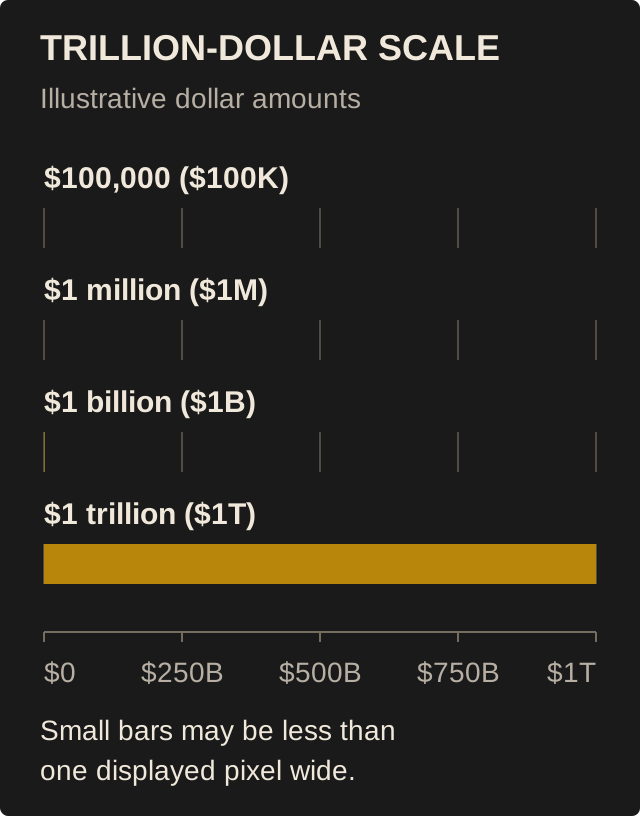
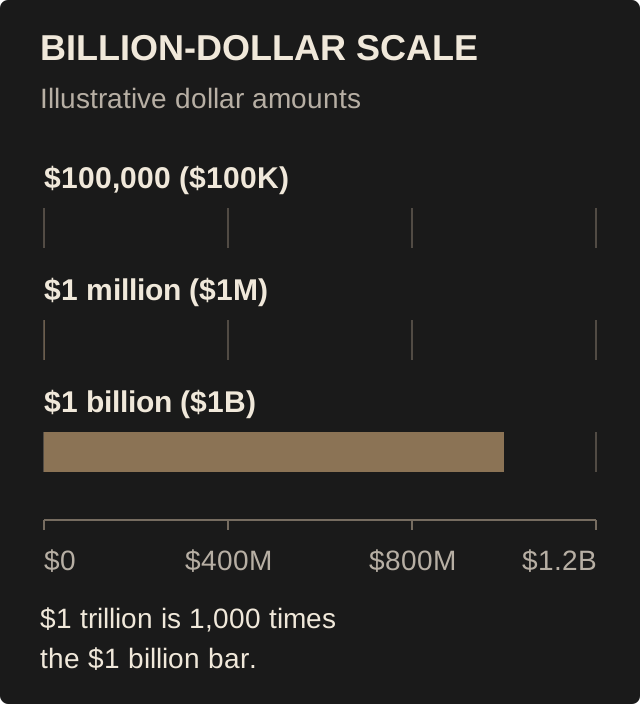
| Dollar amount | Fraction of $1 trillion | Counting time (approx.) |
|---|---|---|
| $100,000 | 1 in 10,000,000 |
1.16 days |
| $1 million | 1 in 1,000,000 |
11.57 days |
| $1 billion | 1 in 1,000 | 31.69 years |
| $1 trillion | 1 (the whole) | 31,688 years |
The system does not need everyone to rise. It needs enough people to sustain it. Enough people working, producing, consuming, competing. Generating the energy that feeds upward while the rewards flow in one direction.
Back to contentsTHE ENDGAME
The system has no brake.
Wealth concentrates. Concentration is not an event. It is a process. It does not reach a peak and level off. It accelerates. The mathematics of compounding guarantee this. The political structures that could interrupt it are staffed by the people who benefit from it. The cultural narratives that could challenge it are produced by institutions funded by it. There is no internal mechanism that slows the concentration. It continues until something external breaks it.
Follow the arithmetic to the bottom.
The bowl does not grow. Population does. Every year, more people compete for the same carrying capacity, or less, because the resources that could expand the bowl are compounding at the top. At some point, the math stops working. There is food for five hundred thousand and the population is one million. There is housing for a city of two million and the people who need it number four million. There is work that pays a living wage for one in ten and the other nine have to figure it out.
When the math stops working, the Locust Effect is no longer a metaphor. It is a prediction. Every argument about individual agency, cultural resilience, community strength, and moral character operates within the resource envelope. Shrink the envelope far enough and those arguments become biologically irrelevant. You cannot practice patience on five hundred calories. You cannot build community when every neighbor is a competitor for the last open bed. You cannot think about next year when you are not certain about tonight.
The phase change does not ask permission. The density removes the choice.
Now follow the arithmetic to the top.
The apex sharpens. Fewer people hold more. The lateral competition intensifies. Number one and number two assess each other across a gap that shrinks every cycle. And the tools they use to compete are not briefcases and conference tables. They are economies. Sanctions. Militaries. Supply chains. Currencies. And, in the final calculation, arsenals capable of ending organized civilization on this planet.
Two or three entities currently hold that capability. The concentration dynamic produced those arsenals. The lateral competition dynamic determines whether they get used. And the people at the bottom, the swarm, the density zone, the ninety-five percent, have no voice in that decision and no shelter from its outcome.
The endgame of MSO is not a stable pyramid with a comfortable top and a pressurized bottom. It is a sharpening spear point. At the base, the swarm grows because the bowl shrinks. At the tip, the final players contest supremacy with the whole world as collateral. And between the base and the tip, the sorting continues. Race. Gender. Caste. Nation. The labels the system uses to organize who descends and who does not.
This document said at the beginning that it is a mirror, not a weapon. That is still true. But a mirror can show you something you did not know you needed to see.
What this mirror shows is simple. The only intervention that addresses the mechanism. Not the symptoms. Not the politics. Not the feelings. The mechanism. Is changing the size of the bowl. Not charity. Charity operates within the existing envelope. Not reform. Reform gets absorbed by the structure. Not moral appeals. The density zone cannot afford to hear them.
The bowl. The carrying capacity at the bottom. The resource envelope within which the Locust Effect operates.
Make it larger and the density drops. The density drops and the pressure eases. The pressure eases and the phase change reverses. The grasshoppers return. Not because people became better. Because the environment stopped demanding that they become worse.
The bowl could be bigger. The resources exist. The food exists. The housing exists. The capacity exists. The bowl is not small because of physics. It is small because every day, in thousands of rooms, specific humans make specific decisions that keep it small. Exchange rates. Interest rates. Wages. Rents. Trade terms. Tax policy. Each one rational from the desk where it was made. Each one a vote to keep the bowl exactly the size it is.
The people making those decisions will never experience the Locust Effect. They are solitary grasshoppers on a hillside, watching the swarm in the valley, setting the density that created the swarm, and wondering why the people down there cannot just calm down.
The bowl could be bigger. That is the only thing the mirror has to say.
What you do with that is yours.
Back to contentsDROP YOUR BANNER
Stop believing the color you choose or the flag you wave has any more effect on your life than your favorite team winning a game.
Political parties are not teams fighting for you. They are brands competing for your alignment. Your vote is not your voice. It is your compliance repackaged as choice. The flag does not feed you. The anthem does not house you. The color of your yard sign does not determine whether you can afford to keep the yard.
While you argue about which side is right, the people at the top do not have a side. They have positions. They fund both. They win regardless. Your loyalty to a symbol is free labor for a system that does not know your name.
And every argument you have with your neighbor is an argument you are not having with the structure. The person across the aisle is not your enemy. The person in a different jersey is not your threat. The person with a different faith, a different color, a different flag. They are standing on the same floor you are. The people who benefit from your division are not standing on that floor. They are above it. And they need you fighting each other, because the moment you stop, you might look up.
You do not choose money. You move through it. Or you get stopped by it.
That is the truth on both sides of every aisle, in every country, under every flag. If you are reading this and something about the way the system operates has never sat right, you are not alone. You are not the first to see it. This is not a secret. This is not new. The structure has been visible the entire time. It just was not profitable for anyone to point it out.
Back to contentsTHE REALITY CHECK
Seeing this does not fix it. Understanding it does not break it. Reading these words does not set you free.
This manifesto only acknowledges it.
Acknowledgment is the first act, not the last. If the bottom does not recognize itself as the bottom, it cannot act as one. If you think your mortgage and your retirement account put you in the cream, you are not seeing the scale. The first and future trillionaires are alive among us. Their wealth grows faster than the bowl expands. And the gap between them and you is not shrinking.
Behavior has become transactional. Pressure has become normalized. Wealth concentrates. Distance grows. Empathy narrows. Community fragments. People filter, ignore, step over, move past. Not because people are broken. Not because humanity is flawed. Because the system is working exactly as designed. It rewards alignment. It punishes deviation. It absorbs resistance. It converts the desperate into fuel and the comfortable into defenders.
Knowing this does not exempt you from it. But not knowing it guarantees nothing changes.
Back to contentsTHE CALL
You do not break this by ignoring it. You do not escape it by pretending it is not there. You do not win by playing harder within rules designed to keep you in place.
You act.
One. See it clearly.
Know what controls outcomes. Know what shapes behavior. Know where you actually stand, not where you think you stand, not where you hope you stand, but where the numbers put you. Clarity removes illusion. Illusion is what keeps the system invisible.
Two. Reduce forced dependence.
Control your time. Lower your constraints. Build optionality. The less pressure you carry, the less the system controls you. Every obligation you eliminate is a chain you remove. Every skill you build is a door you do not need permission to open.
Three. Build outside the pressure loop.
Create systems that are not purely extractive. Strengthen real connections, not networks, not contacts, not followers, relationships. Move toward environments with less pressure. Shift from reaction to construction. Stop responding to the system and start building something the system cannot absorb.
Four. Do not absorb it blindly.
Operating in the system is required. Becoming it is not. You can move through money without letting money become your identity. You can survive the pressure without defending it. You can see the game clearly and still choose to play it on your terms.
Five. Demand a bigger bowl.
The first four are things you can do alone. This one you cannot. The bowl — the carrying capacity, the housing, the wages, the healthcare, the stability — is not small because of physics. It is small because every day, in thousands of rooms, specific humans make specific decisions that keep it small. Interest rates. Exchange rates. Wages. Rents. Trade terms. Tax policy. Each one rational from the desk where it was made. Each one a vote to keep the bowl exactly the size it is.
The people making those decisions will never feel the density. They are above it. They set the pressure and they watch it from a distance. They will not make the bowl bigger on their own, because a bigger bowl means less compression, and less compression means less desperation, and less desperation means less cheap labor, less grateful consumption, less willingness to show up for whatever is offered.
The bowl gets bigger when the people inside it stop accepting its size as natural. It is not natural. It was chosen. Every day it is chosen again. And it can be chosen differently.
You cannot change the interest rate. You cannot rewrite the trade agreement. But you can stop believing the bowl is as big as it can be. You can support the people and the policies and the structures that expand it. You can refuse to vote for anyone who shrinks it. You can measure every proposal, every platform, every promise against one question: Does this make the bowl bigger or smaller? If it makes the bowl smaller, it does not matter what flag it waves or what name it carries. It is not for you. It was never for you.
The system does not need you to break it. It needs you to stop believing it is the only option. The bowl could be bigger. That is not hope. That is arithmetic.
Back to contentsSOURCES & REFERENCES
Research, data, and background reading for this manifesto, organized by section. Bibliographic details and linked sources were reviewed on October 23, 2026. The sources include studies, reports, historical accounts, and theoretical works; the manifesto’s interpretations are the author’s. Each statistic retains its stated observation date.
Section I: The Reality
Exchange Rates and Monetary Policy as Human Decisions
Board of Governors of the Federal Reserve System. Federal Open Market Committee (FOMC). — The FOMC has twelve members and eight regularly scheduled meetings per year; its policy decisions include the target range for the federal funds rate.
Bank for International Settlements (BIS). (2022). OTC foreign exchange turnover in April 2022. — Average daily OTC foreign-exchange turnover was $7.5 trillion in April 2022, across all FX instruments; this is a historical survey observation. Source
Diffuse Intentionality
Mullainathan, S., & Shafir, E. (2013). Scarcity: Why Having Too Little Means So Much. New York: Henry Holt. — Examines how scarcity affects attention, cognitive bandwidth, and decision-making. Source
Hayek, F. A. (1945). The Use of Knowledge in Society. The American Economic Review, 35(4), 519–530. — Classic argument about distributed knowledge in price systems. Poure extends this by noting the directional outcome consistently favors accumulation over distribution. Source
Section III: The Locust Effect
Locust Phase Polyphenism
Anstey, M. L., et al. (2009). Serotonin mediates behavioral gregarization underlying swarm formation in desert locusts. Science, 323(5914), 627–630. — Landmark paper: neurochemical changes mediate density-triggered phase transition. Source
Rogers, S. M., et al. (2014). Rapid behavioural gregarization in the desert locust, Schistocerca gregaria entails synchronous changes in both activity and attraction to conspecifics. Journal of Insect Physiology, 65, 9–26. — Behavioral gregarization occurs within four hours of crowding stimulus. Source
Ma, Z., et al. (2011). Modulation of behavioral phase changes of the migratory locust by the catecholamine metabolic pathway. PNAS, 108(10), 3882–3887. — Examines catecholamine-mediated behavioral phase changes in the migratory locust. Source
Alessi, A. M., et al. (2014). Dopaminergic modulation of phase reversal in desert locusts. Frontiers in Behavioral Neuroscience, 8, 371. — Phase change is bidirectional and neurochemically mediated. Source
Guo, X., Ma, Z., & Kang, L. (2013). Serotonin enhances solitariness in phase transition of the migratory locust. Frontiers in Behavioral Neuroscience, 7, 129. — Important nuance: serotonin’s role may differ between species. Core phenomenon universally accepted; precise pathway debated. Source
Scarcity, Cognitive Bandwidth, and the Bowl
Mani, A., et al. (2013). Poverty impedes cognitive function. Science, 341(6149), 976–980. — In these studies, financial concerns reduced performance on cognitive tests; the authors calibrated the experimental effect to approximately 13 IQ points. The same farmers performed worse before harvest than after harvest. Source
Mullainathan, S., & Shafir, E. (2013). Scarcity. — Book-length treatment of how scarcity captures cognitive bandwidth. Source
de Bruijn, E.-J., & Antonides, G. (2022). Poverty and economic decision making: A review of scarcity theory. Theory and Decision, 92(1), 5–37. First published online in 2021. Source
Sections V & X: Wealth Distribution & Concentration
Oxfam International. (2026, January). Resisting the Rule of the Rich: Protecting Freedom from Billionaire Power. — Oxfam estimates that billionaire wealth grew $2.545 trillion in real terms from 30 November 2024 to 30 November 2025. The 12 richest exceeded combined wealth of poorest half of humanity. Poorest 50% held just 0.52% of global wealth. Source
Oxfam International. (2025, January). Takers Not Makers: The Unjust Poverty and Unearned Wealth of Colonialism. — Oxfam estimates that 60% of billionaire wealth comes from inheritance, monopoly, or crony connections, and projects five trillionaires within a decade. Source
Oxfam International. (2024, September). Multilateralism in an Era of Global Oligarchy: How Extreme Inequality Undermines International Cooperation. — The report estimates that the richest 1% own more wealth than the bottom 95% combined. Source
Forbes. Real-Time Billionaires List. — Continuously updated estimated net worth; individual figures require a dated snapshot.
World Inequality Database. wid.world — Primary academic data source for global wealth and income distribution. Wealth definitions
The r > g Dynamic
Piketty, T. (2014). Capital in the Twenty-First Century. Harvard University Press. — Examines how returns on capital, economic growth, and institutions shape wealth concentration; r > g is one contributing force, not a sufficient condition for indefinitely rising inequality. Source
Jakurti, E. (2025, online publication). A Tale of Two Rates: Return on Capital, Economic Growth, and Wealth Concentration in the Long Run. Review of Political Economy. — In data from 16 developed countries (1870–2020), a one-percentage-point increase in the r–g gap is associated with a 3.7% increase in the top 1% wealth share. Source
Section VI: The Shift — Hierarchy, Stress & Identity
Sapolsky, R. M. (2005). The influence of social hierarchy on primate health. Science, 308(5722), 648–652. — Reviews how social rank affects stress and health; whether higher- or lower-ranking animals bear greater stress depends on social organization. Source
Sapolsky, R. M. (1990). Adrenocortical function, social rank, and personality among wild baboons. Biological Psychiatry, 28(10), 862–878. — Field research on social rank, personality, and stress physiology among wild baboons. Source
Sapolsky, R. M., & Share, L. J. (2004). A Pacific Culture among Wild Baboons: Its Emergence and Transmission. PLoS Biology, 2(4), e106. — Social behavior shaped by environment, transmitted culturally. Source
Fromm, E. (1941). Escape from Freedom. — How people internalize authoritarian structures and build identity around constraint. Source
Bourdieu, P. (1977). Outline of a Theory of Practice. — “Habitus”: social structures written into body and mind without conscious awareness. Source
Section VII: Race, Redlining & the Shrinking Buffer
Racial Wealth Gap and Redlining
Rothstein, R. (2017). The Color of Law: A Forgotten History of How Our Government Segregated America. Liveright Publishing. — Examines government-created residential segregation. Rothstein’s statement attributing the wealth gap largely to federal housing policy is documented in his film narration, quoted by EPI (2019). Source
Aaronson, D., Hartley, D., & Mazumder, B. (2021). The effects of the 1930s HOLC ‘redlining’ maps. American Economic Journal: Economic Policy, 13(4), 355–392. Source
Lynch, E. E., Malcoe, L. H., Laurent, S. E., Richardson, J., Mitchell, B. C., & Meier, H. C. S. (2021). The legacy of structural racism: Associations between historic redlining, current mortgage lending, and health. SSM – Population Health, 14, 100793. — In Milwaukee, historic redlining was associated with poorer physical and mental health roughly eight decades later; the infant-mortality association was not significant. Source
NCRC. (2024). Decades of Disinvestment: Historic Redlining and Mortgage Lending Since 1981. — Black-white homeownership gap wider in 2020 than in 1900. Source
Dettling, L. J., Hsu, J. W., Jacobs, L., Moore, K. B., & Thompson, J. P. (2017, September 27). Recent Trends in Wealth-Holding by Race and Ethnicity: Evidence from the Survey of Consumer Finances. Federal Reserve. — In the 2016 survey, median family wealth was $171,000 for White families and $17,600 for Black families, in 2016 dollars. Source
Aladangady, A., Chang, A. C., & Krimmel, J. (2023, October 18). Greater Wealth, Greater Uncertainty: Changes in Racial Inequality in the Survey of Consumer Finances. Federal Reserve. — In the 2022 survey, median family wealth was $285,000 for White families and $44,900 for Black families, about 6.35 to 1, in 2022 dollars. Source
Maye, A. A. (2023, August 1). Chasing the Dream of Equity: How Policy Has Shaped Racial Economic Disparities. Economic Policy Institute. — Racial wealth gap widened since Civil Rights era. Source
The Shrinking Middle Class as Buffer Zone
Pew Research Center. (2024). The State of the American Middle Class. — The share of Americans living in middle-income households declined from 61% in 1971 to 51% in 2023. Source
Chetty, R., et al. (2017). The Fading American Dream: Trends in Absolute Income Mobility Since 1940. Science, 356(6336), 398–406. — Children earning more than parents fell from ~90% (1940 cohort) to ~50% (1984 cohort). Source
Case, A., & Deaton, A. (2020). Deaths of Despair and the Future of Capitalism. Princeton University Press. — Rising mortality among white Americans without college degrees from suicide, overdose, and liver disease. Directly supports what happens when the buffer zone shrinks. Source
Saez, E., & Zucman, G. (2016). Wealth Inequality in the United States since 1913: Evidence from Capitalized Income Tax Data. Quarterly Journal of Economics, 131(2), 519–578. — The paper estimates that the top 0.1% wealth share rose from 7% in 1978 to 22% in 2012, slightly more than tripling; the bottom 90% share fell from 35% in the mid-1980s to about 23% in 2012. Source
Section IX: The Apex Paradox & Elite Competition
Turchin, P. (2023). End Times: Elites, Counter-Elites, and the Path of Political Disintegration. Penguin Press. — Elite overproduction and wealth concentration produce political instability in predictable cycles. Source
Turchin, P. (2016). Ages of Discord: A Structural-Demographic Analysis of American History. Beresta Books. — Applied structural-demographic theory to American history. Predicted increasing instability in the 2020s. Source
Scheidel, W. (2017). The Great Leveler: Violence and the History of Inequality from the Stone Age to the Twenty-First Century. Princeton University Press. — Scheidel argues that major historical reductions in inequality have followed catastrophic shocks. Source
Holland, T. Rubicon: The Last Years of the Roman Republic. First published in 2003; the linked publisher record describes the 2005 Vintage edition. — Wealth concentration among Roman elite families produced the civil wars that destroyed the Republic. Publisher’s later edition
Section XII: Where the Bombs Fall
Brown University, Costs of War Project. (2021, September 1). Costs of the 20-year war on terror: $8 trillion and 900,000 deaths. — The synthesis estimated about $8 trillion in US post-9/11 war costs, including future veterans’ care, and 897,000–929,000 direct deaths across the studied wars, including civilians and combatants. Source
Laos
Legacies of War. Legacies Library. — More than 2 million tons of ordnance were dropped on Laos in 1964–1973. An estimated 30% of the more than 270 million cluster submunitions failed to detonate; the percentage refers to submunitions, not all ordnance by weight. UNDP’s 2024 UXO programme overview also documents the bombing and continuing clearance. Source
Afghanistan Equipment
Special Inspector General for Afghanistan Reconstruction (SIGAR). (2022, May). Collapse of the Afghan National Defense and Security Forces: An Assessment of the Factors That Led to Its Demise. Interim Report SIGAR 22-22-IP, pp. 33–34. — Citing DoD, estimates $7.12 billion of US-provided equipment previously transferred to Afghan security forces remained in Afghanistan in varying states of repair after the August 2021 withdrawal; its location and operational status were incompletely known. Archived report PDF
Yemen
Campaign Against Arms Trade (CAAT). (2022). Seven years of war in Yemen, seven years of UK complicity. — CAAT estimated around £23 billion in UK arms sales to Saudi Arabia since the war began in 2015, using a broader measure than individual export-licence values. Source
d’Hauthuille, V. (2022, February 15). 10 Conflicts to Worry About in 2022: Yemen. ACLED. — This assessment, covering violence recorded since 2015, estimated more than 150,000 direct fatalities, including civilians and combatants; it does not include indirect deaths from hunger or disease. Source
Lebanon Pager Attacks (2024)
Human Rights Watch. (2024, September 18). Lebanon: Exploding Pagers Harmed Hezbollah, Civilians. — Documents the pager explosions and harm to civilians.
Reuters. (2024, October 16). How Israel’s bulky pager fooled Hezbollah. — Investigates the engineered explosive devices and compromised supply chain.
UN experts, via OHCHR. (2024, September 19). Exploding pagers and radios: A terrifying violation of international law, say UN experts. — Addresses the attacks of 17–18 September 2024 and risks to civilians.
Section XIV: The Endgame
Carrying Capacity
United Nations DESA, Population Division. (2024). World Population Prospects 2024: Summary of Results. — Population estimates and projections, with scenarios and uncertainty. Source
FAO, IFAD, UNICEF, WFP, & WHO. The State of Food Security and Nutrition in the World. Annual report series. — Reports on hunger, food insecurity, and the affordability of healthy diets. Source
Oxfam International. (2026). Resisting the Rule of the Rich: Methodology Note. Statistic 14, PDF p. 10. — Oxfam estimates that about 65% of billionaire wealth gains from 30 November 2024 to 30 November 2025 was equivalent to the estimated cost of closing one year’s global poverty gap at $8.30 per person per day in purchasing-power terms. Source
Nuclear Arsenals
Federation of American Scientists. Status of World Nuclear Forces, 2026. — At the beginning of 2026, nine countries possessed an estimated 12,187 nuclear warheads in total inventories, including retired warheads awaiting dismantlement. The United States and Russia held approximately 86% of the total.
Bulletin of the Atomic Scientists. (2026, January 27). 2026 Doomsday Clock Statement. — The Clock was set to 85 seconds to midnight, its closest setting to date; it is a symbolic expert assessment of global risks.
Core Works: The Intellectual Foundation
These ten works collectively provide the intellectual foundation for the essay’s framework.
Piketty, T. (2014). Capital in the Twenty-First Century. — Concentration dynamics. Source
Piketty, T. (2020). Capital and Ideology. — How inequality regimes are justified. Source
Scheidel, W. (2017). The Great Leveler. — Historical persistence of inequality. Source
Turchin, P. (2023). End Times. — Elite competition and political instability. Source
Sapolsky, R. M. (2004). Why Zebras Don’t Get Ulcers. — Stress and hierarchy. Source
Mullainathan, S., & Shafir, E. (2013). Scarcity. — Cognitive effects of poverty. Source
Rothstein, R. (2017). The Color of Law. — Structural racism in housing. Source
Case, A., & Deaton, A. (2020). Deaths of Despair and the Future of Capitalism. — Human cost of economic decline. Source
Fromm, E. (1941). Escape from Freedom. — Internalization of constraint. Source
Bourdieu, P. (1977). Outline of a Theory of Practice. — How structures become identity. Source
This manifesto is not an academic paper. It is a pattern observed, measured where possible, and stated plainly. The sources above allow any reader to verify the claims and follow the data for themselves. If something in this document moved you, do not take anyone’s word for it, including the author’s. Look it up. The numbers do not lie. The system does.
Money shapes outcomes. Pressure shapes behavior.
Wealth rises, concentrates, and separates.
Most people move within it. Few step outside it.
No one is permanently free from it.
SPEAK FROM THE FLOOR
No names. No accounts. No logins. No cookies. Raw IP addresses are not stored. New visits use keyed hashes that change each day; new comments use stable, keyed anonymous tags. Earlier records are retained. The floor knows you were here.